
Madoka z: My first Encounter with An Itasha
In October 2014, I found myself wandering around Akihabara, on my first trip to Japan. At some point, I ended up on a quiet side street, where I got to see some of the smaller, more niche shops.
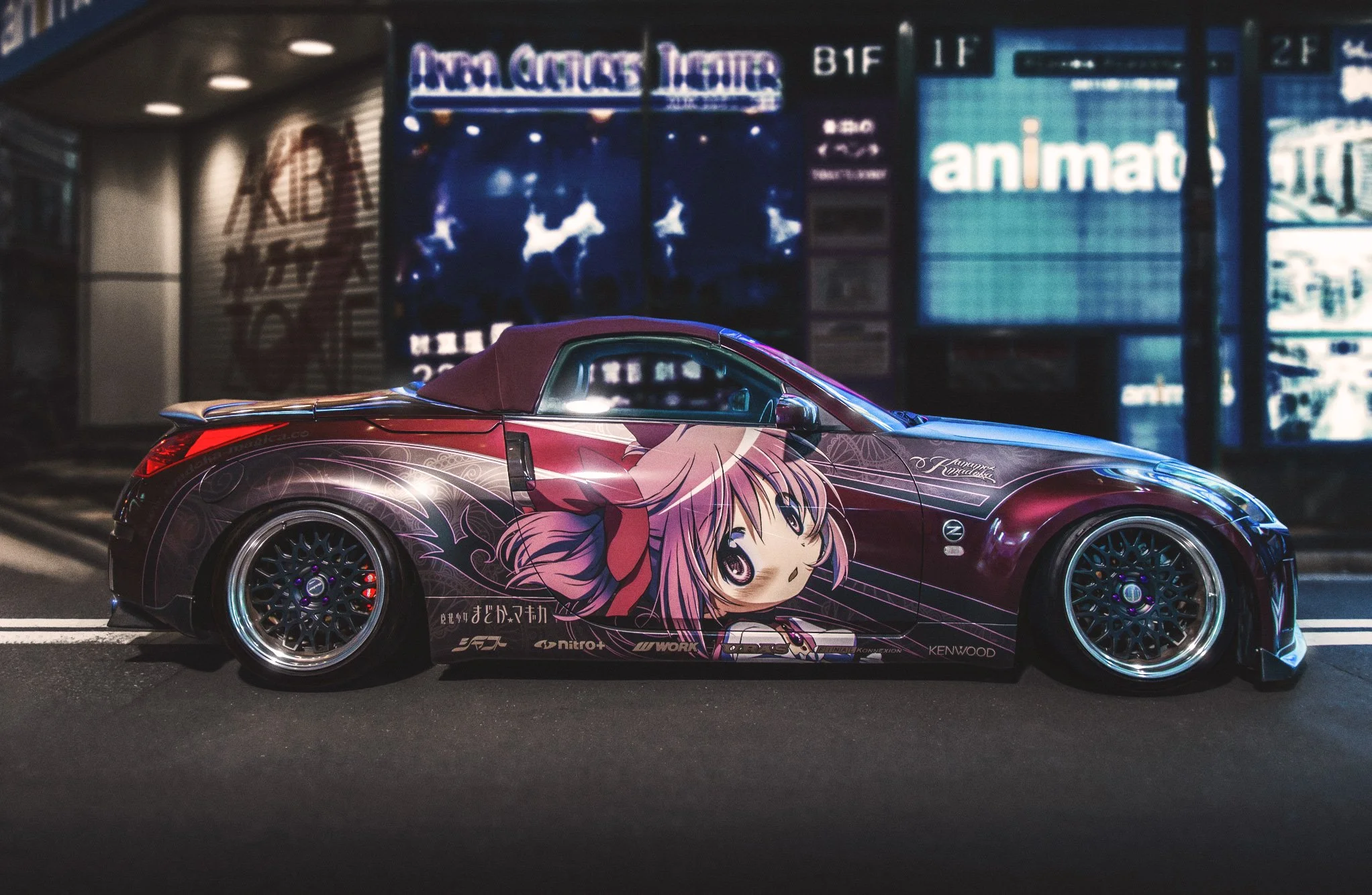
Then, out of nowhere, I saw it: a Nissan 350Z parked next to the Akiba Cultures Zone building.
In October 2014, I found myself wandering around Akihabara, on my first trip to Japan. Most of my visit was spent on Chuo-dori (the main street that runs through the neighborhood), but at some point, I ended up on a quiet side street, where I got to see some of the smaller, more niche shops. I didn’t really have a specific thing I was looking for— I was just enjoying being in that environment and taking it all in.
Then, out of nowhere, I saw it: a Nissan 350Z parked next to the Akiba Cultures Zone building. It was sitting perfectly beneath a streetlight, like a priceless figure in a curio cabinet. Apropos, in my opinion, because this wasn’t your average Z. This one was more art than car, as it was completely covered in an elaborate Madoka Magica design that I couldn’t take my eyes off of. At the time, I didn't know what an "Itasha" was and I hadn’t ever seen anything like it before. Needless to say, I was amazed.
The Connection
Well, I can’t exactly say I’d never seen anything like it before. While I was completely in the dark about Itasha, this car did remind me a lot of the lowriders I grew up around—but with an otaku spin. In fact, if you removed Madoka from the design, it could have perfectly blended into any number of Southern California car clubs. It made liberal use of pinstripe-like and tribal elements, and the color scheme definitely screamed “lowrider” more than it did “anime”. These elements were certainly familiar, yet that didn’t leave me any less confused about what I was looking at.
I didn't really know the context—was this just for show? Or was this part of a the racing scene out here? And why was it just parked here randomly late at night? I knew I wasn’t going to get any answers, but that didn’t matter. I liked what I was looking at, so I pulled out my camera and took a quick photo.
After that, I walked off—expecting to forget about it. But just around the corner were another three vehicles just like the the Nissan. At that point, I knew I had stumbled onto something cool, and it became a fascination that has continued to today.
Then vs. Now: How Things Have Changed
Looking back from 2026, it’s crazy to see how much the scene has blown up. In 2014, I had no idea Itasha existed, and I had to be in a random alley on the other side of the planet before I would encounter one. Now, you can see them at almost any Japanese event in Southern California, and its not that uncommon to spot one in the wild (hell, I just saw a Hatsune Miku Cybertruck a couple of weeks ago in a Costco parking lot).
The cars themselves have changed a lot, too. When I first started seeing them back home, they were fairly straight-forward (as far as Itasha go)—JDM classics, with anime classics plastered all over them. But as time went on, I started seeing more variation and even blending of other car cultures. First with natural progression like stance elements and domestic vehicles, but later, I started seeing more niche things like kaido racers, kei trucks, series-accurate reproduction vehicles, and even some itasha that didn’t feature anime themes at all.
The scene is constantly evolving and its one of the most enjoyable things about this art form.
What I Learned
The biggest takeaway for me—and what I want to share—is just the value of exploring. I wasn’t looking for it. No one introduced it to me. I just took a random turn down a side street and discovered something that is now one of my favorite things in the world.
Would I have eventually discovered it anyway? Most likely, yes, considering how it’s blown up in recent years. But that’s not really the point, either. The truth of this experience is that amazing things exist in the world—most of it entirely outside of our view or immediate reach. You never know what might be waiting for you to discover it, and what kind of impact it will make on your life.
So embrace the unknown and unexpected. Hell, make time to incorporate those into your life, if they don’t come organically. Go for walks. Try new places. Change up your commute route. Do whatever you can to bring more novelty into your life.
And if you like this car, check out some of my other posts on Itasha. You can also follow @Dekocar on Instagram. They often host Itasha at local events throughout Southern California, and are a great way to see more of these gorgeous cars.
Tokyo’s D1 Grand Prix: The Auto Event that Ruined Auto Events for Me
In 2016, I stumbled upon the D1 Grand Prix in Tokyo. It was my introduction to Japanese automotive culture (you know, outside of games and anime), and I loved nearly everything about it.
A few years back, I wrote a semi-critical account of my visit to Nissfest, a Nissan enthusiast event in Irwindale. Normally, I try to keep things positive, but that day I couldn’t shake my disappointment. Don’t get me wrong- I did have some fun at this event. But at the same time, my enjoyment was dwarfed by constant little annoyances and disappointments. It was baffling, because I’ve always loved going to car shows, and I spent my fair share of time at street races in my youth. Yet, something was different now, and looking back, I think my expectations were unfairly colored by my first Japanese auto event: the 2016 D1 Grand Prix in Tokyo.
D1 was my introduction to Japanese automotive culture (you know, outside of games and anime), and I loved nearly everything about it. Naturally, I thought I’d feel the same way at Nissfest, as the two events share a lot in common. Unfortunately, my experiences couldn’t have been more different, and this mismatch is making me wonder if I’m no longer suited to American tuner culture at all.
What Is the D1 Grand Prix?
If you’re reading this because “D1 Grand Prix” caught your eye, you probably know more than I do. My limited knowledge comes straight from Wikipedia: “The D1 Grand Prix (D1グランプリ), abbreviated as D1GP and subtitled Professional Drift, is a production car drifting series from Japan.”
The rest of the wiki article is a bit lengthy, but in short, D1 is one of Japan’s most prestigious and popular drifting competitions, with events that have even expanded outside Japan.
But here’s the twist: I didn’t go to D1 because I was a fan of drifting. In fact, I had absolutely no business being there. I stumbled into it completely by accident.
How I Ended Up at the D1 Grand Prix
My friend and I were in the Odaiba’s DiverCity shopping mall to pick up Tokyo Disneyland tickets from the Disney Store. Upon leaving, we went over to see the massive life-size RX-78 Gundam statue (back then it wasn’t the Unicorn Gundam yet) located just outside the mall. While I was busy taking photos, I noticed a line of people forming nearby.
The line got really long, fairly quick…
Most people would’ve shrugged and moved on. But I was in an adventurous mood and dragged my friend over to see what it was all about. Looking back, I’m actually kind of surprised got in line. My friend and I didn’t speak Japanese (at least not fluently) and the entrance sign was a little ambiguous, so there was no way to know what was in store for us.
That random decision paid off, however, as it turned into one of my favorite memories of that Tokyo trip.
Experiencing D1 Firsthand
The D1 Grand Prix was unlike any car event I’d experienced before. From the moment I walked in, I was hooked. Drift demonstrations, vendor booths, and rows of incredible cars—it had everything. One display even featured the (then new) 2nd-Gen Honda NSX (a real treat, as a fan of the first gen model). Best of all, it didn’t feel too crowded (which is unusual for anything in Tokyo, but I didn’t question it).
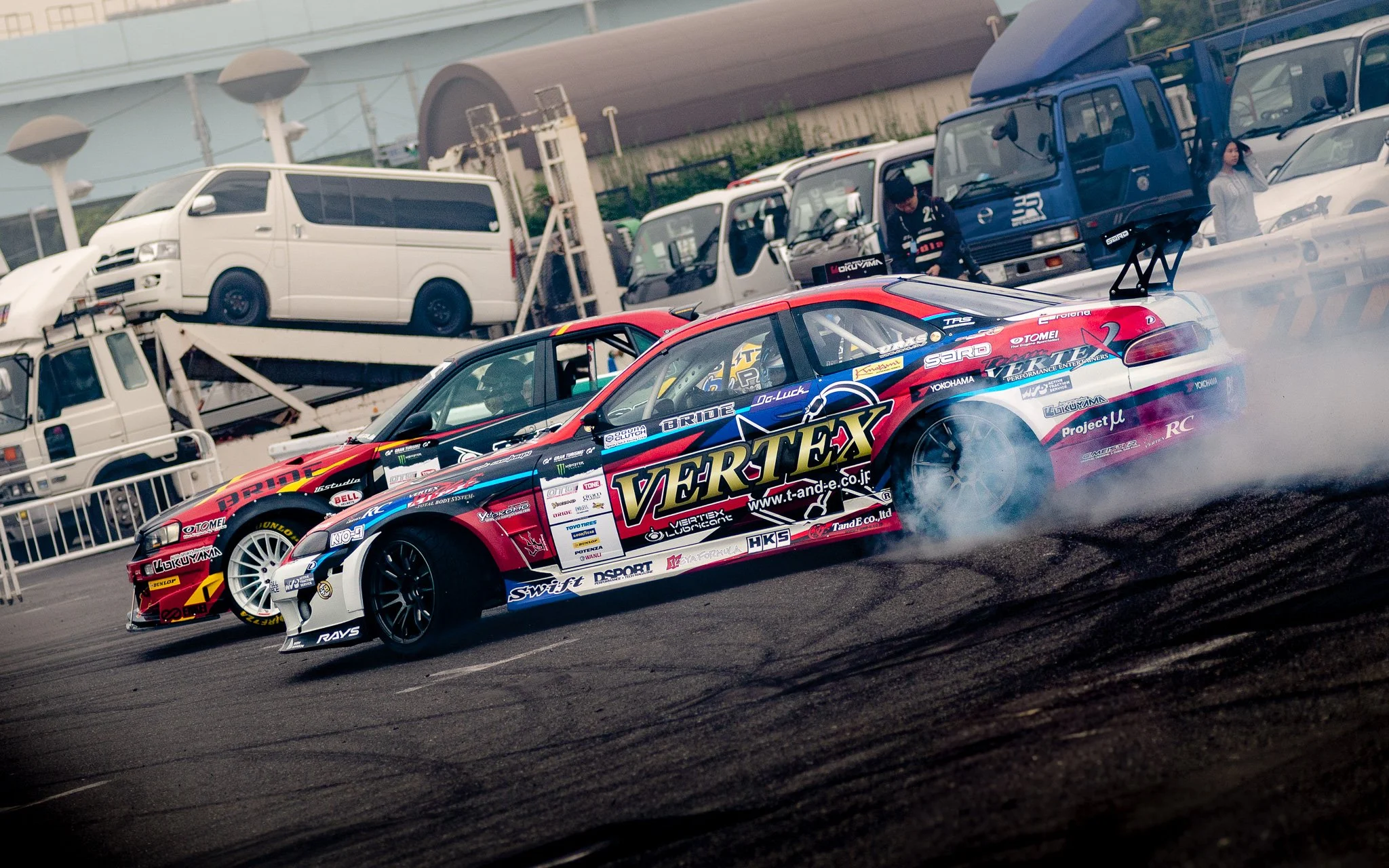
The drift demos were a big highlight. Cars would drift side-by-side in a small area adjacent to the vendor booths and event stage. Not just that- fans could even sign up to ride in the cars during the demonstrations, though unfortunately I couldn’t join because the forms were all in Japanese. Still, I had a blast just spectating and taking photos. The viewing area sat right up against the action, which worked out perfectly since was limited by the three prime lenses I brought for this trip: a 14mm ultra-wide, a 50mm, and a 90mm macro. You can read more about my mistaken rationale regarding these lenses in an earlier post, but suffice to say, it made some scenarios a challenge to shoot. Thankfully, that wasn’t the case with this event.
How D1 Differed From Events in the U.S.
What struck me most wasn’t the cars—it was the atmosphere. Compared to the tuner-ish events I’d attended here at home, D1 was so much more laid back. It was incredibly refreshing.
The crowd was also diverse: kids, teens, young adults, and even old guys. Everyone seemed equally excited to be there, and the vibe was energetic without being obnoxious. Unlike many of the car shows I’ve attended in the U.S., there were no burnouts, no shouting matches, no blaring sound systems competing for attention, and absolutely no “let’s see whose exhaust is loudest” contests. Just cameras snapping, music from booths, and plenty of chatter and laughter.
That absence of noise and chaos made the whole event a joy to experience. After attending D1, it’s no wonder that Nissfest left me feeling so sour.
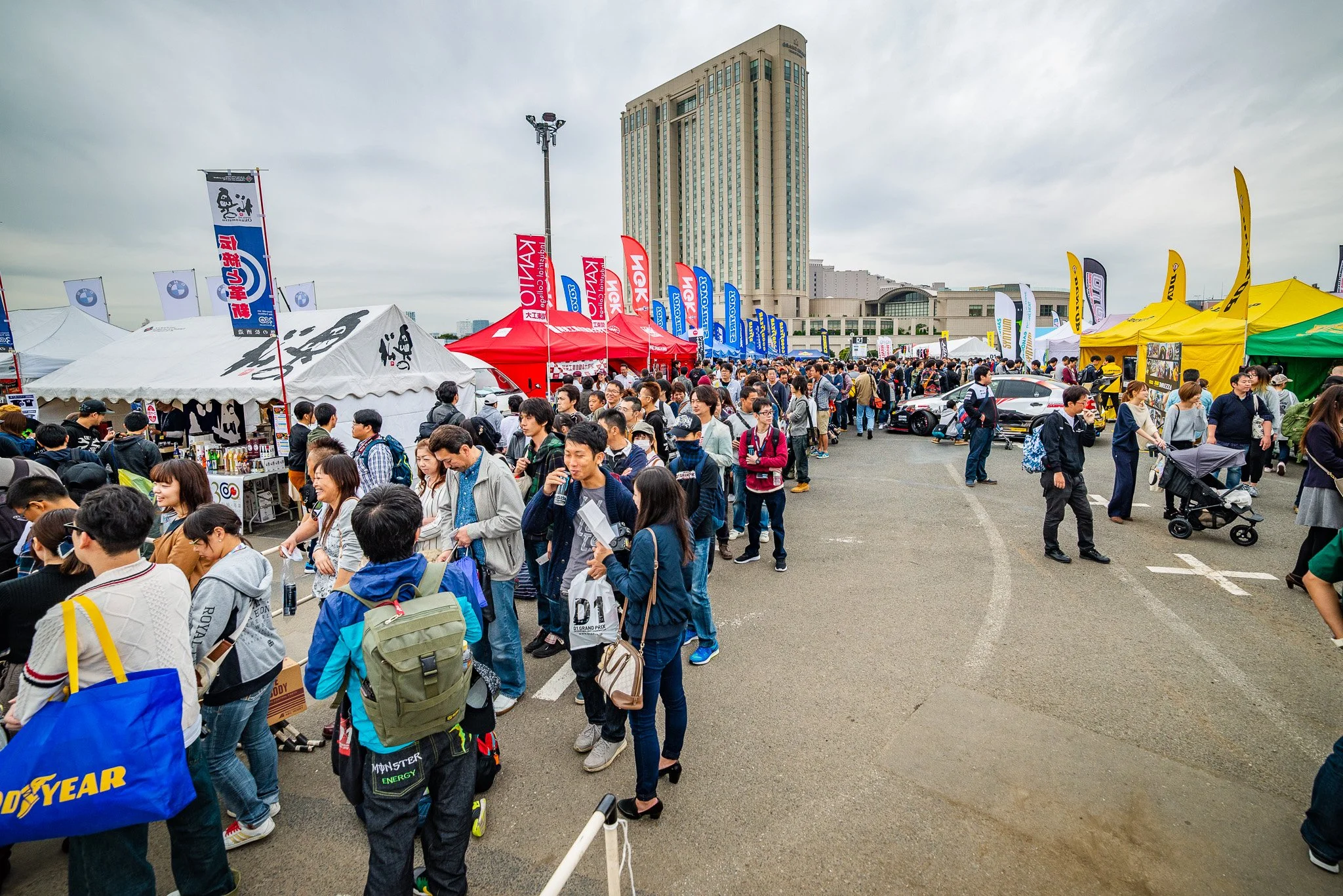
The crowd at D1. Orderly lines and a calm atmosphere.
Meanwhile, here is a crowd shot at the last Nissfest I attended. I’m pretty sure this was an impromptu revving contest.
The Not-So-Perfect Side
Of course, not everything was flawless. The main “Grand Prix” racing portion required separate tickets, and thanks to the language barrier, I never figured out where to buy them. I also wished the event itself had been larger, since the booths and displays were so much fun to explore.
And then there were the camera guys. Yeah, I get that booth models are part of the auto scene, but some of these dudes straight up hound the ladies for photos. And its not just one or two guys. At one point there was a model showcase on the stage, and a sea of cameras arise whenever they posed for the crowd.
Them’s a looooot of cameras…
Truthfully though, I’m still undecided on how I feel about it. It’s why they’re there, after all (both the models and photographers), and the disrespectful photographers were more the exception than the norm. But it still felt off to me, and even a little cringe. Nonetheless, I’m an outsider to both D1, and the Japanese auto scene as a whole. So its possible that all this is completely normal and expected here.
This is a fairly calm-looking shot, but there was actually a random photographer to the right barking commands at them.
Final Thoughts: Why D1 Still Stands Out
D1 set a new bar for me. It had everything I enjoyed most from car events, but with almost none of what I dislike. And once you have an experience like that, its kind of hard to go back.
These days, I stick to itasha displays and classic car shows. These kinds of events have more of the kind of energy that I vibe with now. They tend to be calmer, slower-paced, and they have more opportunities to really take in what they have to offer- cars, art, and great community.
And too be fair, not all American tuner events are bad. The truth is that I’m probably just aging out of the scene. I’m not in my twenties anymore, and I have to accept the fact that my tolerance for loud noises, rubber smoke, and an overall lack of consideration has faded. But 20 years ago? I would have been all over an event like Nissfest and loving every bit of it.
Thankfully, D1 showed me that there are still events out there for me- I just gotta go looking for them. By following my curiosity, I stumbled into one of my favorite Tokyo memories. Even now, years later, it remains a high point for me, and an experience that I hope to capture again some day.